
Most “AC not cooling” calls trace back to a dirty filter, a wrong thermostat setting, or a blocked outdoor unit, and checking those three first fixes the problem before you spend a dime. If you find ice on the indoor coil or the quick checks don’t help within 20 minutes, stop troubleshooting and call a licensed technician. Under EPA Section 608, refrigerant work is restricted to certified pros anyway, so that’s the ceiling of what any homeowner should attempt.
TL;DR:
- Most “AC not cooling” issues are caused by simple problems like dirty filters, incorrect thermostat settings, or blocked outdoor units, which homeowners can troubleshoot themselves first.
- The recommended diagnostic order is thermostat, airflow, frozen coil, outdoor condenser, refrigerant, and finally the compressor, to avoid unnecessary expenses.
- Signs like ice on the coil, a humming outdoor fan, or short cycling indicate more serious issues that require professional attention and should prompt immediate shutdown and call for service.
- Duct leaks, debris, or improper sizing are less common but can cause uneven cooling and should be checked if a specific room or floor remains warm.
- Homeowners should only attempt basic fixes and call licensed technicians for refrigerant work, compressor repairs, or electrical issues to avoid safety hazards.
Table of Contents
- Why Is My AC Not Cooling? Start With These Checks
- What’s the Right Order for Diagnosing AC Cooling Problems?
- Common Causes of an AC That Runs but Won’t Cool
- When Should You Stop and Call a Professional?
- Checking and Cleaning the Condensate Drain Line
- Inspecting the Blower Motor and Fan
- Symptoms and Effects of a Faulty or Dirty Condenser Fan
- Impact of Dirty or Malfunctioning Evaporator Coils Beyond Freezing
- Air Duct Inspection for Blockages or Leaks
- A Note From Airconditioning-heating on Getting Fast, Accurate Help
- Get a Licensed Technician Out Fast
- Sources
- FAQ
Why Is My AC Not Cooling? Start With These Checks
The reason so many service calls end quickly is that technicians work through the same short list before touching anything mechanical. You can do the same thing in under 15 minutes, and even if it doesn’t solve the problem, you’ll walk away with exactly the details a technician needs to bring the right parts on the first visit.
- Thermostat. Confirm it’s set to COOL, not just FAN, with the fan switch on AUTO rather than ON. Set the target temperature at least 3°F below the current room reading, and swap the batteries if the display looks dim or unresponsive.
- Air filter. Pull it out and hold it up to a light. If you can’t see light through it, replace it. Note the size while you’re there, whether it’s a thin 1-inch filter or a thicker 4-inch media filter, and its MERV rating, since a higher-MERV filter in a system not designed for it can restrict airflow enough to cause the exact problem you’re chasing.
- Breakers and disconnect. Check the indoor breaker panel and the outdoor disconnect box near the condenser. A tripped breaker that resets and trips again is a sign of an electrical fault, not something to keep resetting.
- Outdoor unit clearance. Clear leaves, grass clippings, or overgrown shrubs from around the condenser, and confirm the fan on top is actually spinning.
- Registers and returns. Open any closed vents and make sure furniture or rugs aren’t blocking return air grilles.
Give the system some time after these fixes, then feel the air coming out of a nearby register.
Pro Tip: Keep your phone handy and jot down what you saw at each step, ice, no fan movement, a humming sound. That single list can cut a technician’s diagnostic time in half.
Routine filter changes and coil care prevent most of this in the first place; maintaining peak performance year round matters more than people expect.
What’s the Right Order for Diagnosing AC Cooling Problems?
Skipping ahead to guesses about the compressor before ruling out a $15 filter is how homeowners waste money and how technicians get called back twice for the same job. The order matters because each stop is cheaper and faster to check than the one after it, and most problems get caught early.
The sequence: thermostat → airflow → frozen coil → outdoor condenser → refrigerant → compressor. ServiceMag notes that the vast majority of “AC not cooling” calls resolve within the first three stops, and IndoorBreathing’s troubleshooting guide backs the same order, calling out that thermostat, filter, and breaker checks alone typically take about ten minutes.
Watch for these signs at each stop:
- Ice on the indoor coil or refrigerant lines. Turn the system off immediately; do not chip at the ice.
- Outdoor fan not spinning but the unit is humming. This usually points to a failed capacitor, not a dead compressor.
- Warm air at the supply registers despite cold air at the return. Check the actual temperature split, not just how the air feels.
- Short-cycling, where the system turns on and off every few minutes. This often means airflow restriction or a control issue rather than a refrigerant problem.
That last point about temperature is worth measuring directly. Hold a thermometer at a return grille, then at a supply register near the same room. A healthy central AC system typically shows a 16 to 22°F drop between the two. Anything under about 14°F tells you the system is working but underperforming, which is a useful number to hand a technician on the phone.
If you smell burning, hear grinding metal, or see a breaker trip more than once, stop immediately and cut power at the breaker. That’s not a DIY moment anymore.
Common Causes of an AC That Runs but Won’t Cool
Once the quick checks are done, the underlying cause usually falls into one of six buckets, and each comes with a different urgency level and price tag.
- Restricted filter. A clogged filter starves the indoor coil of airflow, and the coil gets cold enough to freeze the moisture around it. Replace filters regularly depending on type and pet presence; the fix itself is typically inexpensive.
- Frozen evaporator coil. Power the unit off and let it thaw fully, which can take several hours. AC Units Guide advises never chipping the ice off manually. If the coil refreezes after a fresh filter and a full thaw, that’s a strong signal of low refrigerant or a weak blower motor, not a one-time fluke.
- Dirty condenser coil or blocked outdoor unit. Dirt and grass clippings caked on the outdoor coil trap heat inside the system, raising head pressure and cutting cooling capacity. A coil rinse with a garden hose (power off first) often restores performance; professional coil cleaning runs modestly higher if it’s caked with years of buildup.
- Failed run capacitor or contactor. ServiceMag identifies a bad capacitor as one of the most common reasons a unit hums but the outdoor fan never starts. It’s also one of the cheaper fixes.
- Low refrigerant from a leak. A system doesn’t just “run low” on refrigerant over time the way a car uses gas. If the charge is low, there’s a leak somewhere, and a technician has to find it with UV dye or an electronic sniffer before recharging. This work falls squarely under EPA Section 608 certification requirements.
- Compressor failure. Symptoms include a humming sound with no cooling at all, or a unit that trips the breaker repeatedly. On a system more than ten years old, replacing the compressor alone often costs close to what a full system swap would run, which is the real decision point.
Cost reality check: ServiceMag’s repair data puts capacitor and contactor repairs in the low hundreds of dollars, refrigerant leak diagnosis plus recharge in the roughly $400 to $1,200 range depending on leak location, and compressor replacement in the thousands, which is why catching the cheaper causes early actually matters financially.
Ductwork issues, like a disconnected supply run in an attic or a return that’s badly undersized, cause cooling complaints too, especially in rooms that never seem to cool no matter what the thermostat says. They’re less common than the causes above but worth flagging if only one zone of the house runs warm.
When Should You Stop and Call a Professional?
Homeowners can safely handle filter swaps, breaker resets, thermostat settings, and clearing debris around the condenser. Everything past that point involves either high voltage or refrigerant, and both carry real risk.
Never attempt these yourself:
- Opening the compressor or high-voltage electrical compartment on the outdoor unit
- Swapping a run capacitor, which can hold a dangerous electrical charge even when the power is off
- Adding refrigerant or repairing a refrigerant leak
- Replacing a compressor
The EPA restricts refrigerant handling to certified technicians under Section 608 for good reason. Improper recharging can damage the compressor, void a manufacturer warranty, and in some cases create a safety hazard.
Call for same-day service if you notice any of these:
- A hissing sound near the indoor or outdoor unit
- Ice that hasn’t thawed after several hours with the system off
- A burning smell from the indoor air handler or outdoor unit
- A breaker that trips more than once after resetting
- Loud grinding, screeching, or banging from the outdoor unit
Pro Tip: Don’t run the system while waiting for a technician if you’ve spotted ice or heard hissing. Repeated operation with a frozen coil or a refrigerant leak accelerates compressor wear, turning an affordable repair into a much more expensive one.
Checking and Cleaning the Condensate Drain Line
A clogged condensate drain doesn’t usually cause warm air by itself, but it’s a frequent side effect of the same neglect that causes bigger cooling problems, and it can force a modern system to shut down entirely as a safety measure. Most residential air handlers have a float switch that cuts power to the compressor the moment the drain pan fills, which some homeowners mistake for a cooling failure when the system is actually protecting itself.
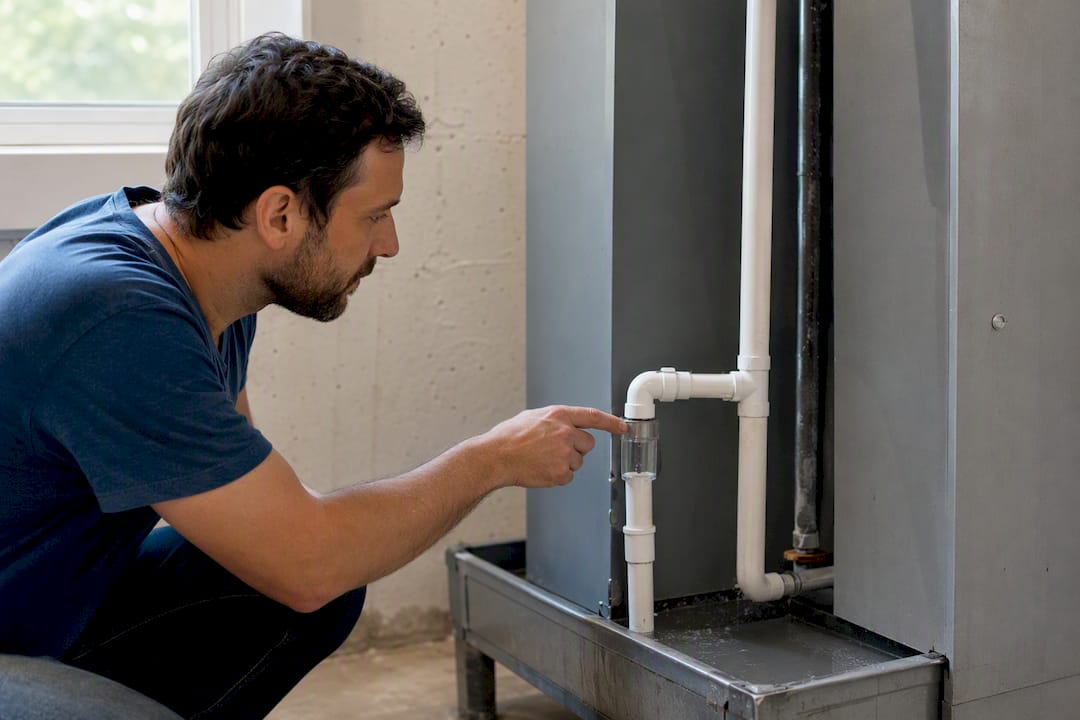
Locate the drain line, usually a PVC pipe running from the indoor air handler to an exterior wall or a floor drain. Look for standing water in the drain pan under the air handler, or water stains on the ceiling below an attic-mounted unit. A clear PVC cleanout tee, if your system has one, lets you check for a slow trickle versus a full blockage.
Algae and mold buildup are the usual culprits. Pouring a cup of distilled vinegar into the drain access point every few months keeps growth in check, and a wet/dry vacuum applied at the outdoor termination point can pull a full clog free in most cases. If water backs up again within days, or you can’t locate a clear access point, that’s a job for a technician rather than repeated vacuuming attempts.
Skipping this maintenance step is a common reason otherwise healthy systems get shut down mid-summer, and it’s one of the more preventable failures the entire list.
Inspecting the Blower Motor and Fan
The blower motor pushes cooled air through your ductwork, and when it’s weak or failing, you get exactly the symptom that brings people searching for “AC not cooling”: a system that runs, even blows air, but never quite reaches a comfortable temperature. A struggling blower can’t move enough air across the evaporator coil, which drops airflow low enough to risk the coil icing over again even with a clean filter.
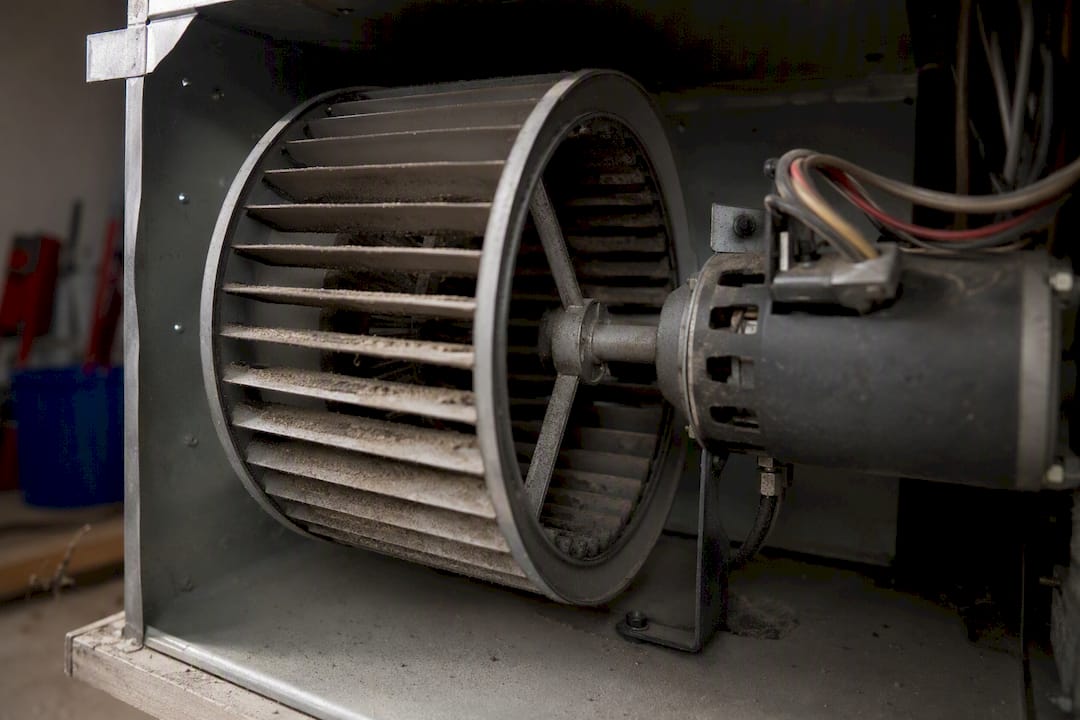
Listen at the indoor air handler, usually a closet, attic, or basement unit. A healthy blower produces a steady, even sound. A failing one often produces a rattle, a repeating click, or a motor that seems to strain to reach speed. Weak airflow at every register in the house, not just one room, points toward the blower rather than a duct problem specific to one run.
Check the blower’s own air filter access, since some systems have belts or additional filters near the motor that get overlooked during a standard filter swap. Dust buildup on the blower wheel itself, a squirrel-cage-shaped fan, reduces airflow efficiency even when the motor runs fine mechanically, and that’s a cleaning job most homeowners are better off leaving to a technician given the electrical connections involved.
A blower motor that’s still spinning but clearly underpowered is one of those slow-decline problems: it degrades over months, not overnight, so if your system has felt “just a little weaker” for a while rather than suddenly warm, this is worth mentioning specifically when you call for service.
Symptoms and Effects of a Faulty or Dirty Condenser Fan
The condenser fan, mounted on top of the outdoor unit, pulls air across the outdoor coil to release the heat your system extracted from inside the house. When that fan stops working or slows down, heat has nowhere to go, and the whole system loses cooling capacity fast, sometimes within minutes of startup.
A unit that hums loudly from the outdoor cabinet but shows no fan movement at all is one of the clearest signals of an electrical issue, usually the run capacitor mentioned earlier, though a seized fan motor bearing is also possible. A fan that spins but wobbles, ticks, or runs noticeably slower than it should is often coated in dirt and debris on the blades, which throws it out of balance the same way a dirty ceiling fan does.
Dirty condenser fan blades, or a coil packed with cottonwood fluff, pet hair, or landscaping debris, force the compressor to work harder against higher pressure just to move the same amount of heat. Over time, that added strain shortens compressor life, which turns a cheap cleaning job you skipped into an expensive repair down the line.
If you can safely and visually inspect the outdoor unit with the power off, check for bent fan blades, visible debris packed between the coil fins, and any oily residue, which can indicate a refrigerant leak at a fitting near the fan motor. A fan that’s clearly running but the unit still isn’t cooling points further down the diagnostic list toward refrigerant charge or the compressor itself.
Impact of Dirty or Malfunctioning Evaporator Coils Beyond Freezing
Ice buildup gets most of the attention, but a dirty evaporator coil causes real cooling loss long before it ever freezes over. A layer of dust and grime on the coil fins acts like a blanket, insulating the refrigerant inside from the air passing over it, which is the entire mechanism that makes an air conditioner work.
The result is a system that runs constantly, pulls the same amount of electricity, and delivers noticeably less cold air, often the exact “AC blowing warm air” complaint homeowners describe before anyone spots visible ice. A frozen coil is frequently the product of more than one stacked failure, a restricted filter plus a marginal refrigerant charge, or reduced airflow plus a weakening blower, rather than one single cause. That’s part of why a technician who finds ice will typically check several systems, not just replace the filter and call it done.
A coil that’s dirty but not yet frozen tends to show up as a slow decline in performance over a cooling season rather than a sudden failure. Rooms take longer to cool, energy bills creep upward, and the temperature split between return and supply air narrows below the healthy 16 to 22°F range mentioned earlier. Left unaddressed, a persistently dirty coil raises the odds of the freeze cycle happening again even after a fresh filter, because the underlying airflow restriction never actually went away.
Professional coil cleaning, part of most seasonal HVAC maintenance visits, typically resolves this without needing any refrigerant work at all.
Air Duct Inspection for Blockages or Leaks
Ductwork problems are lower on the probability list than a dirty filter or a failing capacitor, but they explain a specific pattern that other causes don’t: one room or one floor stays warm while the rest of the house cools normally. If your home ac not cooling upstairs is the actual complaint rather than the whole house running warm, ducts deserve a look before you assume the outdoor unit is at fault.
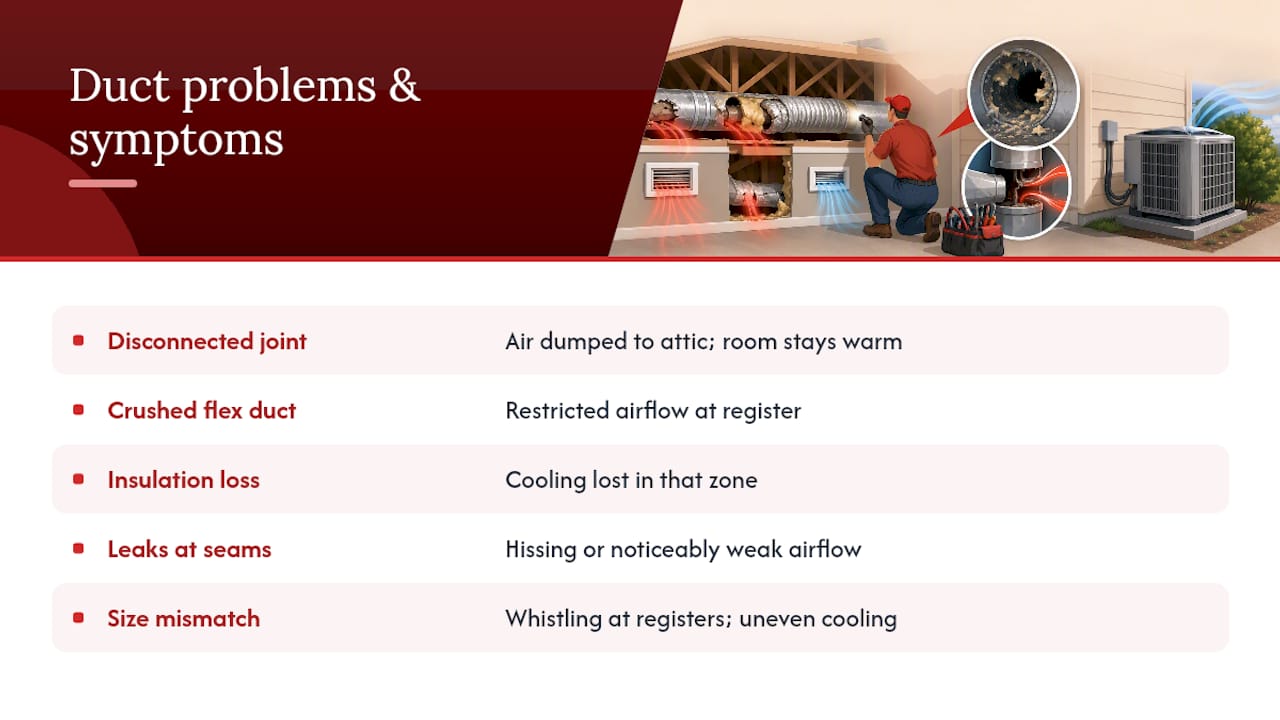
Accessible duct runs in an attic, crawlspace, or basement are worth a visual check for disconnected joints, crushed flex duct, or insulation that’s fallen away from a metal trunk line. A disconnected supply duct in an attic can dump conditioned air into unconditioned space entirely, which explains why a system can run nonstop and still never satisfy the thermostat.
Leaks at duct seams, often at the metal collar connections rather than the middle of a run, show up as a hissing sound near accessible ductwork or as noticeably weaker airflow at the register served by that run compared to others in the house. A sizing mismatch, ducts that are too small for the system’s airflow output, produces a different symptom: whistling at the registers and rooms that cool unevenly even with clean filters and a healthy outdoor unit.
Sealing and insulating ductwork is genuinely a job better suited to a technician with the right mastic and testing equipment, since a DIY seal job with the wrong tape often fails within a season. If duct problems seem likely, duct repair service is the right category of fix to request rather than another refrigerant check.
A Note From Airconditioning-heating on Getting Fast, Accurate Help
Airconditioning-heating connects homeowners and property managers with licensed local contractors rather than dispatching technicians directly, which means the referral itself is fast, but the diagnostic work still happens on-site by a vetted pro. Before requesting a referral, jot down what you observed: whether the outdoor fan was spinning, any humming without startup, ice on the coil, and whether you already reset the breaker.
That short list, backed by routine seasonal maintenance history if you have it, speeds up diagnosis considerably. Expect a diagnostic fee on the initial visit and a same-day or next-day arrival window in most cases, with the technician confirming findings and cost before any repair begins.
— Ygal
Get a Licensed Technician Out Fast
If the quick checks didn’t fix it, or you’ve spotted ice, a hissing sound, or a compressor that just hums, the fastest path forward isn’t another hour of guesswork. It’s getting a licensed HVAC contractor on-site who can confirm the cause and quote the fix on the spot.

Airconditioning-heating connects you with vetted local contractors for exactly this kind of call, with a diagnostic fee upfront and no guesswork about who’s showing up at your door. Financing options are available for larger repairs like compressor or coil replacement, so an unexpected failure doesn’t have to mean paying the full bill at once. If your AC is running but not cooling, request a referral through the AC repair booking page and get a same-day or next-day technician matched to your specific symptoms.
Sources
- AC Not Cooling: Troubleshooting Central Air From the Thermostat to the Compressor | ServiceMag
- Section 608 – EPA
- Central Air Conditioner Not Cooling: Causes and Fixes – IndoorBreathing
- When to Call an HVAC Technician? | AC Units Guide
FAQ
Should I turn off my AC if it’s not cooling?
Yes, if you see ice on the coil, smell burning, or hear hissing. Running the system in those conditions accelerates compressor damage and turns a moderate repair into a major one.
How do I reset my AC if it’s not cooling?
Turn the thermostat off, flip the outdoor disconnect and indoor breaker off briefly, then restore power and switch the thermostat back to COOL. If it trips again immediately, stop and call a technician rather than resetting repeatedly.
How do I get my AC cold again?
Start with the thermostat, filter, and outdoor unit clearance, since those three checks resolve the majority of cases according to ServiceMag’s troubleshooting data. If the coil is frozen or the temperature split stays below 14°F after those checks, the fix requires a licensed technician.
Why is my AC not giving out cool air?
The most common causes are a clogged filter restricting airflow, a dirty condenser coil trapping heat outside, a failed run capacitor keeping the outdoor fan from starting, or low refrigerant from a leak. Working through them in that order, thermostat first and refrigerant last, avoids unnecessary cost.
Is it normal for AC to run but not cool the house?
No. A system that runs continuously without cooling almost always points to a specific fault, most often reduced airflow, a dirty coil, or a refrigerant issue, and it’s worth diagnosing rather than letting it run and hoping it improves.

